Room needs privacy (bedroom or bathroom)
A bedroom or bathroom door has one job before any other: block sight lines and cut sound transfer between rooms. Glazed French doors fail that test outright — the glass panes carry light and, depending on the pane, a fair amount of sound straight through, so they belong between shared living spaces, not in front of a toilet or a bed.
Specify an unglazed panel door or a flush door in solid wood instead. Both give an uninterrupted face with no glass to see through or rattle. Simpson Door lists bedroom and bathroom doors as a distinct category from its French and glazed lines for this reason.
Heavier, solid-wood construction also improves sound isolation compared with a hollow-core slab, because there's more mass to absorb vibration rather than pass it through. That mass is also what raises the price per door — the buyer is paying for board feet of lumber, not just a faced shell. In a bathroom specifically, wood's tendency to swell with humidity is a separate concern from privacy, and it's worth checking a door's finish and edge sealing before installing it in a wet room, since unsealed edges are where moisture gets in first.
Buyer wants visible wood grain
If the goal is to see the wood itself — its figure, color variation, and species character — the door needs a stain-grade finish, not paint. A stain-grade door is built and selected specifically so its grain shows through a clear or tinted topcoat, which means the species and the cut of lumber become part of the finished look rather than something hidden. LuxDoors sells stain-grade interior doors as a separate line from painted stock for this reason.
Species selection then drives both appearance and price at once — a tight, uniform grain in a common species costs less than a figured or exotic grain in a premium one. If visible grain isn't the point, a paint-grade door finished in white or another solid color is the cheaper route, since it can be built from a less expensive substrate that the paint covers completely.
Interior room is dark or feels closed off
A room that feels closed off is usually losing light at the doorway, not the window. Before changing the door, check whether the wall between the two rooms can borrow light — that means confirming the opening isn't load-bearing in a way that limits how much glass the door can carry, and that the adjoining room has enough light to share in the first place.
Where that checks out, a French or glass-lite interior door lets light pass between the two spaces without removing the door entirely. ETO Doors lists French and glazed styles specifically for interior openings where light transfer is the goal. The trade-off is the one described above: reduced privacy and reduced sound blocking, which is why this fix belongs on studies, home offices, and dining rooms rather than bedrooms or bathrooms.
Closet or tight opening has no swing clearance
Whether a door can swing at all depends on the floor space in front of the opening, not on style preference. Measure the width of the opening and the clear floor space on the room side before choosing a door type — a swinging door needs room for the full arc of the slab, which a tight hallway or closet wall often doesn't have.
- If the opening is a standard closet width and swing space is the limiting factor, use a bifold door, which folds against itself and needs only shallow clearance.
- If there's enough adjacent wall space for a slab to travel sideways, a barn-style sliding door removes the swing requirement entirely and works well on wider openings.
- If neither condition is met, a pocket door recessed into the wall solves the clearance problem but requires the wall cavity to be opened during installation, which matters most in a renovation rather than new construction.
French door
A French door is a glazed door, most often installed in pairs, used to connect two interior spaces while letting light and sightlines pass between them. ETO Doors carries French doors specifically as an interior-connector category, distinct from its bedroom and bathroom lines. Because the glass runs most of the door's height, French doors suit dens, dining rooms, and home offices better than any space where privacy or sound isolation matters.
Panel door
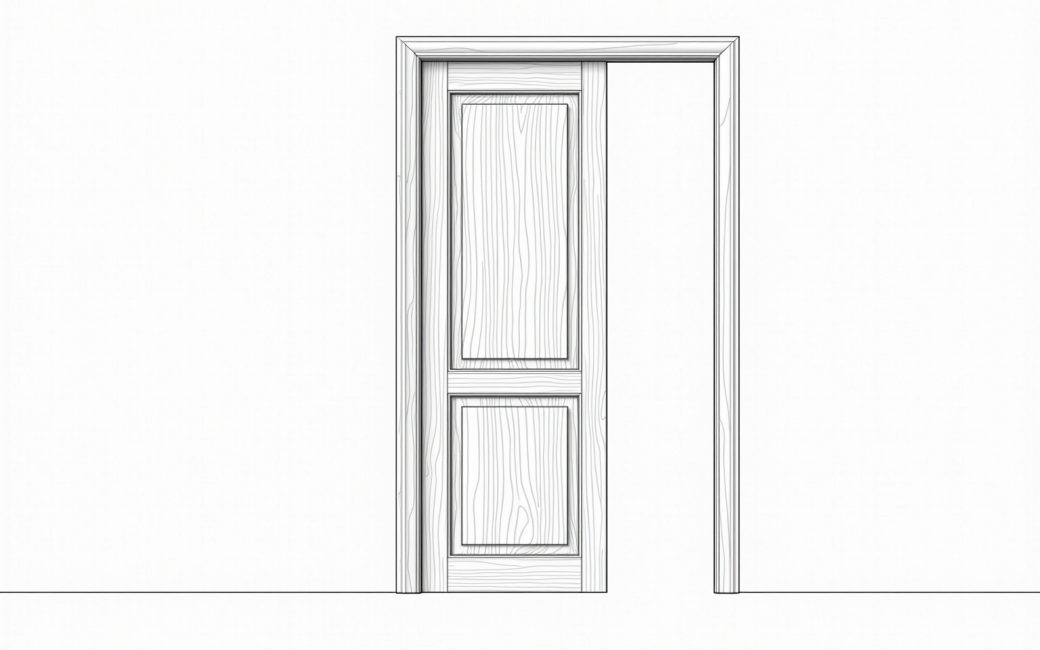
A panel door has its face divided into raised or recessed sections framed by solid stiles and rails, rather than one continuous flat surface. This construction is what gives shaker- and traditional-style doors their shadow lines, and it's built from thicker, more substantial stock than a flush door's face, which is part of why panel doors typically cost more per unit. Vintage Doors builds its solid-wood line almost entirely around panel configurations for this reason.
Flush door
A flush door is the opposite construction: a flat, unbroken face with no raised or recessed detail. That simplicity makes it the standard choice for a modern or minimalist interior, and it's also the easiest face to paint evenly since there are no corners or profiles to catch finish unevenly. Flush construction is available in both solid wood and hollow-core builds, so a flush face alone doesn't tell you how heavy or sound-isolating the door will be — that depends on what's between the two faces, covered below.
Price
Cost per interior wood door depends on three things stacking together: construction (hollow core, solid core, or solid wood), species, and finish grade. Hollow-core doors sit at the bottom of that stack because they use the least material; solid-wood doors sit at the top because every board foot inside them is structural lumber, not a veneer over a lighter core. Solid Hardwood Doors frames solid wood construction as the premium tier specifically because of the labor and lumber volume involved, rather than any surface treatment. Panel doors generally cost more than flush doors of the same construction because of the added milling, and stain-grade doors in a figured species cost more than paint-grade doors in a common one, since paint-grade stock doesn't need to look good on its own.
Interior wood door
An interior wood door is any door used inside the home and built from wood rather than steel or fiberglass, and it comes in three basic operating types: swinging (hinged), sliding (barn-style or pocket), and folding (bifold). Which type fits a given opening is a measuring question, covered above, not a style question. A second decision that applies to all three types is slab versus prehung: a slab is the door alone, sized to fit an existing, square frame, while a prehung door arrives already set into its own jamb and hinges, sized for a rough opening rather than a finished one. Nick's Building sells prehung wood interior doors specifically because most replacement jobs need the frame corrected along with the slab, not just the slab swapped.
Solid wood construction
"Solid" gets used loosely in interior doors, and it covers three different builds with different weight, sound, and price. A hollow-core door has a thin wood or composite skin over a cardboard or lattice interior — light, inexpensive, and the weakest at blocking sound. A solid-core door has a dense engineered fill inside a wood-veneer skin, adding weight and sound resistance without the cost of solid lumber. A true solid-wood door is built from stiles, rails, and panels of actual lumber all the way through, which is what Vintage Doors and Solid Hardwood Doors both mean when they use "solid" in their names — it's a construction claim, not a marketing word, and it's worth confirming which of the three a listing actually describes before comparing prices.
Wood species
Species is what decides grain pattern, hardness, and where a door lands on cost, and it matters most on a stain-grade door where the wood itself is the finish.
| Species | Relative cost | Hardness/durability | Grain character |
|---|---|---|---|
| Pine | Lowest | Softer, dents more easily | Visible knots, informal grain |
| Alder | Low–moderate | Moderate | Fine, even grain, takes stain well |
| Oak | Moderate | Hard, resists dents well | Strong, open grain pattern |
| Maple | Moderate–high | Very hard | Tight, subtle grain |
| Mahogany | Highest | Hard and dimensionally stable | Rich color, fine straight grain |
Simpson Door offers its interior line across several of these species specifically because hardness and grain drive different rooms' needs — a high-traffic hallway benefits from a harder species like oak or maple, while a low-traffic study can use pine or alder without a durability penalty.
Stain-grade finish
A stain-grade finish is a clear or tinted topcoat applied over a door built and selected to show its wood grain, rather than a solid paint color that hides the substrate underneath. Because the wood itself is visible, a stain-grade door has to be built from a species and a cut of lumber worth looking at — which is why LuxDoors markets stain-grade as its own product line rather than a finish option applied after the fact. Choosing stain-grade locks in the species decision above it, since a paint-grade substrate underneath a clear coat will show every seam and patch a paint job would have hidden.
Measure the opening, decide between slab and prehung, and match the species to the room's traffic and moisture before ordering — those three decisions, in that order, settle most of what a wood interior door will cost.