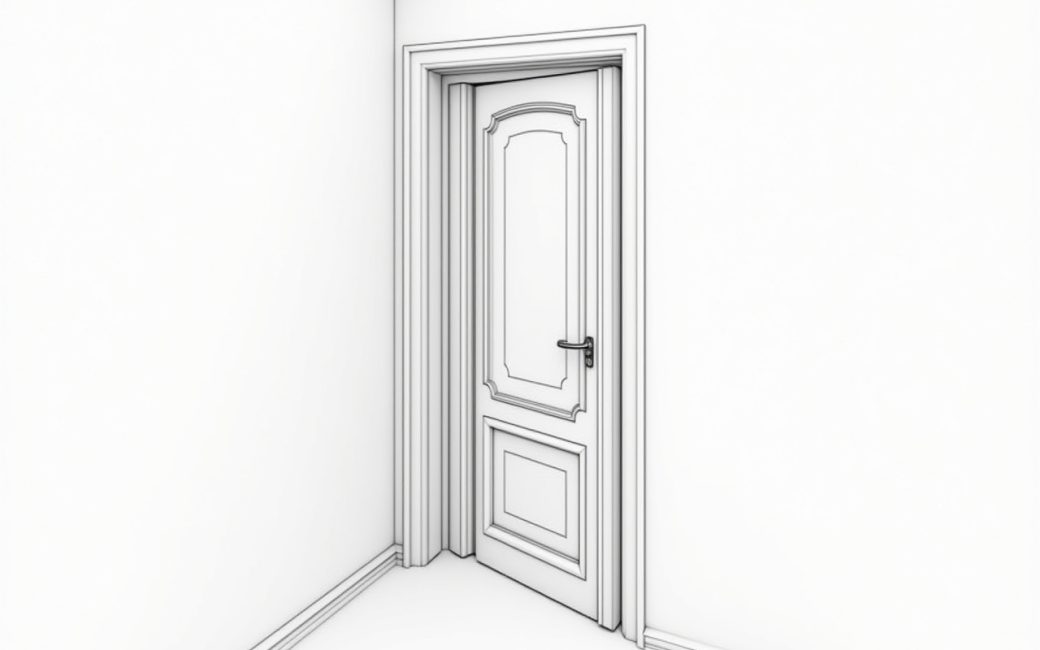
Room needs privacy (bedroom or bathroom)
A door chosen for a bedroom or bathroom has one job before any other: block sightlines and dampen sound. That single requirement rules out several popular styles before cost even enters the conversation.
Glazed French doors, however well they suit a dining room or home office, transmit both light and sound across the opening. Any door with lite (glass) panels fails a privacy test by design, since the glazing area is precisely where sound and sightlines travel. For a bedroom or bath, specify an unglazed panel door or a flush door in solid wood instead — a flat, unbroken face with no glass and no seams for sound to leak through.
The trade-off is price. A heavier, denser slab isolates sound more effectively than a lightweight one, and that added mass is exactly what raises the per-door cost. Framing a budget around a bedroom or bathroom door means paying for mass and fit, not for decorative glazing — the extra dollars go into the core of the slab and the seal at the jamb, not into anything visible from across the room.
Buyer wants visible wood grain
If the goal is to see the wood itself — grain, figure, color variation — the door has to be stain-grade, meaning it's built and finished specifically to be viewed as wood rather than covered over. A paint-grade door can use lower-grade lumber or engineered cores because the finish coat hides the substrate; a stain-grade door can't hide anything, so both the lumber quality and the joinery have to hold up under a clear or lightly tinted finish.
That single choice then drives the species decision. Oak, maple, and cherry each take stain differently — oak's open grain reads more strongly through a stain coat than maple's tighter, more uniform grain, and cherry darkens on its own with age regardless of finish. Species selection at this stage is doing double duty: it sets the final appearance and it sets a large share of the door's cost, since stain-grade lumber in a desirable species costs more than the paint-grade equivalent.
The panel style chosen underneath the stain matters just as much as the species. A raised panel — where the center of each panel is milled thicker and bevelled up toward the frame — throws shadow lines that make the grain and the joinery read as more traditional and more ornate. A recessed (flat) panel sits below the surrounding frame instead of standing proud of it, giving a plainer, more contemporary look with fewer shadow lines to draw the eye. Shaker style takes the recessed idea to its simplest form: a flat panel set inside a square-edged frame with no bevelling or decorative routing at all, which is part of why it costs less to produce than a raised-panel door in the same species.
For anyone who decides grain isn't actually wanted after weighing the appearance against the price, the cheaper route is a paint-grade door finished in white — a substrate that doesn't need to look like anything in particular, since the paint is doing all the visual work. Painted finishes aren't purely a cost-saving fallback, either; a painted door surface can become the decorative element in its own right, as shown by one hand-painted front door project that turned a plain white slab into a floral centerpiece.
Interior room is dark or feels closed off
A dark or closed-off interior room usually has a fixable cause: an opaque door is blocking daylight that's available on the other side of the wall. Before ordering anything, check whether the adjacent room actually has light to borrow — a windowless closet on the other side won't help a hallway no matter what door goes in.
If there is light to borrow, a French door or glass-lite interior door lets it pass through the opening instead of stopping at the jamb. This is a direct fix, not a style preference, and it should be treated as a trade against the privacy point raised above: gaining light and openness through glazing means giving up the sound and sightline blocking that a solid panel or flush door would have provided. A reader deciding between the two should be deciding based on which room actually needs which property, not on which looks better in isolation.
Closet or tight opening has no swing clearance
Before choosing a door style for a closet or a narrow opening, measure the opening width and check how much wall space sits beside it — that measurement decides the style, not preference.
- If the opening is narrow and there's no floor space for a door to swing into the room, a bifold door folds back on itself and needs only shallow depth to clear.
- If there's flat wall space beside the opening — enough to cover the width of the slab — a barn door slides along that wall on a track and needs no swing clearance at all inside the room.
- If neither condition is met (no fold clearance, no wall run), a standard hinged swinging door remains the only option, and the room layout may need to change to accommodate it.
Turning the choice into a clearance measurement rather than a style vote avoids ordering a door that physically won't operate in the space.
Interior wood door
An interior wood door, at its simplest, is a movable barrier built from wood and set into an opening inside a home, distinct from the exterior doors built to resist weather. The Cambridge Dictionary defines a door plainly as a piece of wood, glass, or metal, fixed in place and used for opening and closing an entrance — a definition broad enough to cover every style discussed above, from flush to French to bifold, panel to shaker. What separates one interior wood door from another in practice is what's inside the slab and what's cut into its face, which is where cost differences actually live.
Beyond the practical function, the word carries weight it didn't need to in a hallway. A door marks a threshold — the line between one space and another — which is part of why it shows up so often as a figure of speech rather than just a fixture: an open door as an opportunity, a closed door as a refusal. The custom of painting an entrance a distinctive color, such as the red front doors associated with Irish homes, and the recurring use of "door" as a threshold image in religious and literary writing both draw on that same idea — the door as the marked point of passage, not just the panel that swings on it. None of that changes how a bedroom or closet door should be specified, but it explains why the word carries more than its function.
Solid wood construction
"Solid" gets used loosely, and that looseness hides real cost and performance differences. A solid wood door is milled from lumber all the way through — heaviest, most expensive, and most resistant to sound transmission of the three constructions. A solid core door has a dense composite or engineered filler inside a wood veneer skin, giving much of the sound-blocking and heft of solid wood at a lower material cost. A hollow core door has a cardboard or lightweight lattice interior under a thin veneer, making it the lightest and cheapest option but also the poorest at blocking sound and the easiest to damage.
The three aren't interchangeable substitutes for the same job — a hollow core door in a bedroom wall will not deliver the privacy a solid core or solid wood door provides, no matter how similar the two look from the hallway, and the price difference between the three tiers is exactly where an interior door budget is won or lost.
Wood species
Species choice affects three things at once: how the door looks under a clear finish, how the wood handles daily use, and what the door costs. Oak is dense and prominently grained, which reads clearly under stain but also makes the door heavier and pricier. Maple has a tighter, more even grain that takes paint cleanly and stain more subtly, making it a common choice when a buyer wants a stain-grade look without oak's strong figure. Pine is softer and cheaper than either, which makes it a common paint-grade choice, but that softness also means it dents and scratches more readily in daily use.
None of these trade-offs stand alone — a species chosen for its grain under a stain-grade finish may not be the right species for a bathroom, where the moisture in the air can cause wood to swell and warp regardless of how attractive the grain looked in the showroom.
Stain-grade finish
A stain-grade finish is a commitment made before the door is ordered, not an option applied afterward — the lumber and joinery underneath have to be good enough to be seen. That's what separates it from a paint-grade approach, where the finish coat is designed to cover imperfections rather than reveal them.
Choosing stain-grade also means accepting that the final color depends on the species' natural grain and porosity as much as on the stain itself; two different woods under the identical stain color will not look the same, and a raised panel will show that color differently than a flat shaker panel because of how light falls across the bevelled edge. Anyone set on a specific finished color, rather than a specific wood, is usually better served starting from a paint-grade door and a chosen paint color — including, as shown above, a finish that becomes a deliberate decorative surface rather than a neutral background.
Measure the opening, decide whether privacy or light matters more for that room, and match the construction type, species and panel style to that answer before comparing quotes on price alone.